We’ve all seen the tests the police do when they think someone is drunk. Walk a straight line, follow their finger, touch your nose then their finger. But what do these tests do?
Alcohol first effects your cerebellum, which controls balance, coordination, and eye movement among other things. When you drink, your cerebellum isn’t as effective, which makes these tests much harder to pass.
These tests expose the symptoms of ataxia, a dysfunction in the cerebellum. Ataxia can show up as an episode or can be a long-term condition. Genetics, a brain injury, or chronic alcohol use can also cause it.
Most of the cells in the cerebellum are Purkinje cells, which are very susceptible to damage from conditions like ataxia. These neurons are inhibitory, or in other words, they stop actions from happening. Purkinje neurons make up the only output information that comes from the cerebellum.
Purkinje cells smooth and refine voluntary movements. These include anything from walking to swallowing. When the cerebellum (and Purkinje cells) is damaged, these movements become more rigid and less precise. People with ataxia can therefore have far less control over their muscle movements and balance.
A 2009 study by Mahyar Janahmadi and a team at Shahid Beheshti University used a neurotoxin called 3-acetylpyridine (3-AP) to cause ataxia in rats. They then used riluzole or a combination of riluzole and 3-AP to try and treat the symptoms. They saw that that riluzole could be used to protect Purkinje cells from neurodegeneration. It also slows some degeneration in the cerebellum.
Riluzole is a drug that is used to treat ALS and has worked in treating some of the symptoms of ataxia as well. Research hasn’t revealed just how it works with the nervous system, but it appears to prevent excitatory impulses. In order to suppress excitation, riluzole would have to inhibit activity from the neurotransmitter glutamate.
Glutamate is the most common neurotransmitter that excites activity in a neuron. It does this by lowering the minimum charge needed to generate an impulse that can be carried to the next neuron. By blocking glutamate, making an impulse would be harder, and the neuron would remain inactive for longer.
If riluzole works this way, it would have a large effect on cerebellar neurons. Purkinje cells are inhibitory, so they make further neuronal activity harder than normal. Riluzole’s potential function would stop some of the negative outputs from Purkinje cells.
This would look like less information coming from Purkinje cells in the cerebellum. Normally this makes your coordination worse, like when you are tipsy. But, if someone already has damage in their cerebellum, this could suppress some of their symptoms instead.
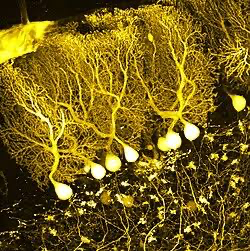
Purkinje neurons are a major cell type in the cerebellum. Their fan-shape allows them to connect with many other Purkinje cells and other neurons in the cerebellum and other parts of the brain.
Add comment
Comments