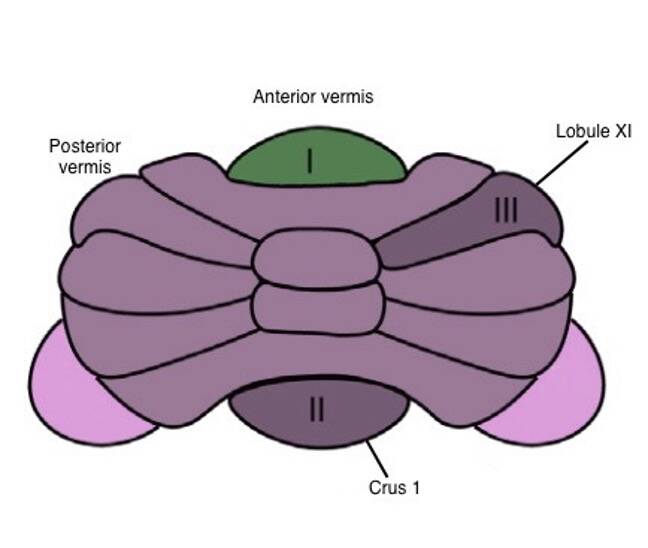
If you’ve heard of the cerebellum, it’s probably been related to balance. More recently though, research has shown that it has a role in behavior too. The Astrotactin 2 (ASTN2) is all over in the cerebellum, and missing it causes behavioral disorders, as well as other impairments. ASTN2 works be receiving signals coming into the cerebellum and regulates activity in inhibitory Purkinje cells.
Purkinje cells are a very large type of neuron in the cerebellum. They have far more branches and connections than most neurons. Their unique branching also allows them to share large amounts of information with one another and learn very quickly.
People missing ASTN2 are more likely to have autism spectrum disorder, ADHD, learning difficulties, or language delays. Additionally, children that sustain an injury to the cerebellum at birth are 40 times more likely to have ASD. A loss of Purkinje cells is also a common indicator of ASD postmortem.
A study published in 2024 by the Proceedings of the National Academy of Sciences of the United States of America, found that reducing the amount of ASTN2 protein in the brain causes fundamental changes to neurons in the cerebellum and other effected areas.
Michalina Hanzel and her team of researchers used CRISPR-Cas9 to prevent the ASTN2 protein from being produced in the cerebellum or entire brain of mice. All of the mice with less of the protein made fewer vocalizations, were less curious, and had hyperactive and repetitive behaviors.
They conditioned the mice to blink on cue, which was harder for mice missing the ASTN2 protein. The cerebellum times actions like blinking, which is impaired by the absence of ASTN2. An intermediate (heterozygous) group of mice, with less ASTN2 than normal, had fewer symptoms than mice without the protein.
When the research team looked at the cerebellum under a microscope, they saw that the dendrites (branches that carry information to the center of a neuron) had fewer branches than normal. Hanzel found that the mice that were missing ASTN2 in their entire brain also had issues during development with connecting with the cells that guide neurons to their permanent location. Mice with ASTN2 ‘knocked out’ just in the cerebellum had some hyperactivity and were somewhat repetitive. Their social skills, curiosity, and coordination didn’t change though.
Purkinje cells in the cerebellum normally have lots of dendrite branches, but the loss of ASTN2 led to a decrease in them. That makes it harder for cells to communicate with other Purkinje cells and farther brain areas.
Just changing how much ASTN2 protein is in the cerebellum makes a big difference in the way it works. In the past it hasn’t gotten as much attention because it doesn’t serve any crucial functions. The connections in the cerebellum are crucial though for making our movements precise and it even informs are behavior! This study shows us that our cerebellum does a lot more than help us balance!
- CRISPR-Cas9 is a process for editing genes using a “guide” RNA sequence and Cas9 protein to break open the DNA sequence make changes to it.
Add comment
Comments