Have you ever tried to tickle yourself? My guess is it didn’t work. But why?
Sarah Blakemore and her colleagues found the answer in 1999 when they found that the cerebellum was predicting felt sensations.
Some of the things that cerebellum is best known for are planning out and correcting movements. Blakemore, Wolpert, and Firth also thought that these predictions would be different with sensations caused by yourself versus something else.
They found that the cerebellum distinguishes sensations made by yourself or something else before that information reaches the sensory area of your brain. They also saw less brain activity in the cerebellum from when a self-generated movement causes actual touch (tactile stimulation), versus an outside movement.
The cerebellum is essentially telling your sensory system to ignore a stimulus that you make yourself. It sorts out the irrelevant information coming in from the sensory areas of your brain. The extra cerebellar activity when you move means that your cerebellum makes more predictions about what you will feel.
The prediction activity in the cerebellum contributes to the ‘‘forward model’’. This is an understanding of our motor movements. The idea is that our brains make predictions about a series of movements before we do them, and before we consciously decide what to do.
The study was quite small, with six volunteers (four females and two males) who were all right-handed and an average of 33 years old. Each volunteer had 200 scans in a functional MRI (fMRI) while experiencing external or self-generated movements, with or without touching. An fMRI shows the changes in activity in your brain while you complete a task.
The fMRI scans showed that the cerebellum and somatosensory cortex had higher levels of activity during a tactile stimulus that was made by something else, rather than the volunteer themselves. This suggested that your brain can distinguish between felt stimuli that come from you, and something else.
The somatosensory cortex processes touch, pressure, temperature, pain, and your sense for where your body is and what it is doing. This information gets delivered to your cerebellum, where it can predict what comes next.
The researchers could actually use the different activity in the somatosensory cortex and cerebellum to tell the difference between the types of sensations! So, you can’t tickle yourself because your brain is just too quick.
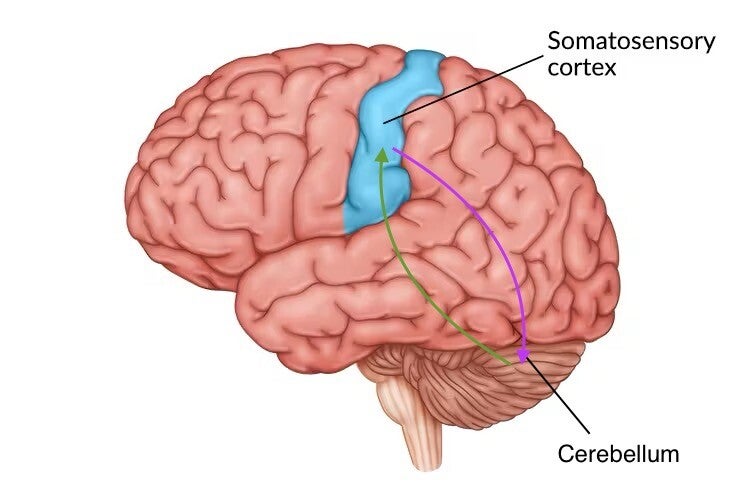
Information passes between the somatosensory cortex and the cerebellum.
Somatosensory Cortex Damage: Symptoms, Treatment, and Recovery. (Kellogg, 2022.) https://cdn.flintrehab.com/uploads/2020/03/somatosensory-cortex-damage.png
Add comment
Comments