Catherine Theys, Elina Jaakkola, Tracy R. Melzer, Luc F. De Nil, Frank H. Guenther, Alexander L. Cohen, Michael D. Fox, and Juho Joutsa
Stuttering is often a developmental disorder that can result in communication problems and social anxiety. However, stuttering can also be acquired from damage to certain brain areas, the most common cause being a stroke. The purpose of this study was to find common brain regions that are common between people that develop stuttering after a stroke and those with persistent developmental stuttering that began when they were young.
This study was conducted in three parts, (1) studying case reports of people that began stuttering after a stroke, (2) clinical studies of stroke patients with an acquired stutter, and (3) clinical studies of adults with persistent developmental stuttering. A map of the lesion areas reported from groups 1 and 2 was compared with group 3 to assess common effected brain structures that resulted in stuttering.
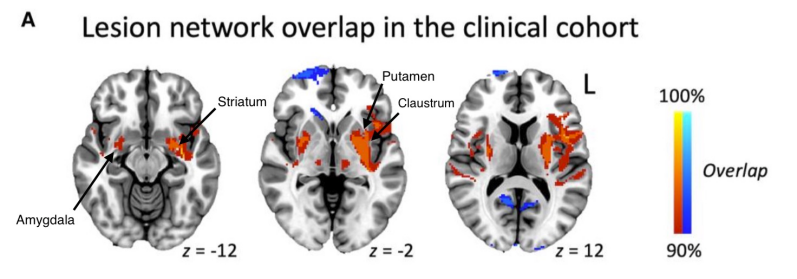
The result of these comparisons showed that in both stroke-induced and persistent developmental stuttering, a network connecting the posteroventral (to the back and lower portion) putamen, the ventral (lower) claustrum, and amygdalostriatal transition areas of the left hemisphere was significantly involved in both types. The gray matter tissue in the network connecting these areas was greater in people with persistent developmental stuttering, and the more mater corresponded with the severity of the stutter. However, the volume of gray matter in the putamen is less than normal in children with developmental stuttering.
It was postulated that the putamen is the most important part of this network because it is responsible timing and sequencing motor movements, the posterior area regulating the movements of the lips and face. Additionally, the left posterior putamen contributes to the learning and habituation to movements, which is demonstrated in developmental stuttering, which often is established with the increase in language development at age 4-5.
The claustrum is connected with the brain’s cortex and possibly compiles sensory information, as well as the motor planning, coordination, articulation, and execution involved with speech. This area also participates in negative emotions from poor social interactions, which would explain the greater emotional consequences due to the social impact from the stuttering, corresponding with the amount of gray matter in the associated regions.
Add comment
Comments